
Ghana’s Wildlife Division Marks World Wetlands Day 2026 with Call to Protect Keta Lagoon

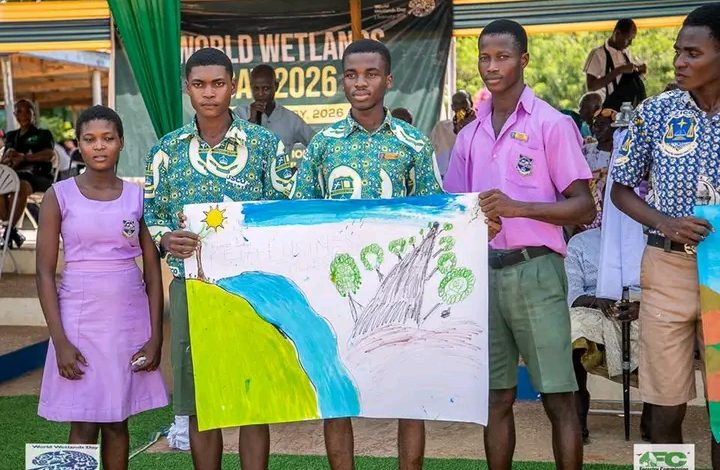
The Wildlife Division of the Forestry Commission has marked World Wetlands Day (WWD) 2026 with a grand durbar at Anlo Senior High School, focusing on the urgent need to protect the Keta Lagoon Complex Ramsar Site.
Observed globally on February 2, this year’s celebration was held under the theme “Wetlands and Traditional Knowledge: Celebrating Cultural Heritage,” highlighting the deep connection between indigenous practices and wetland conservation.
Chiefs, Government Officials Call for Action
Chairing the event, the Awadada of Anlo State, Togbui Agbesi Awusi II, urged residents to uphold ancestral practices that preserved the Keta Lagoon for generations. He described wetlands as the “kidneys of the planet,” noting that they support nearly 40 percent of global wildlife species.
Delivering remarks on behalf of the Forestry Commission’s Chief Executive, Dr. Hugh Brown, the Deputy Chief Executive, Elikem Eric Kotoko, acknowledged growing threats to Ghana’s wetlands—including unregulated development, sand winning, pollution, and overexploitation. Despite these pressures, he said the Commission remains resolute in its conservation mandate.
Kotoko announced an updated mission statement for the Commission: “To Protect, Sustainably Manage and Develop Ghana’s Forest and Wildlife Resources”—a revision he said reflects the institution’s growing emphasis on resource protection.
He revealed that the Wildlife Division currently deploys 544 wildlife guards and 152 members of its Rapid Response Team, supported with enhanced logistics to strengthen enforcement. Three Community Resource Management Areas Angor, Dusornu and Avu Lagoon have also been established around the Keta Lagoon to boost local participation and livelihood support.
Local Assemblies Reaffirm Commitment
A speech delivered on behalf of the Keta Municipal Assembly by Divine Saviour Agbeviade reaffirmed the Assembly’s pledge to integrate traditional knowledge with modern conservation methods.
Similarly, the District Chief Executive for the Anloga District Assembly, Sandra Seyram Kpedor, encouraged students and young people to draw inspiration from the celebration, stressing that wetland protection is both an environmental and developmental priority.
Wetlands “Disappear Three Times Faster Than Forests”
Speaking for the Executive Director of the Wildlife Division, Joseph Binlinla underscored the critical but often overlooked role of wetlands in supporting water security, climate resilience, biodiversity, and livelihoods.
He warned that wetlands are disappearing three times faster than forests, with nearly 90 percent already degraded globally.
He highlighted ongoing conservation efforts at the Keta Lagoon—ranging from mangrove restoration to climate-resilient livelihood initiatives—supported by partners such as the International Union for Conservation of Nature, the European Union, A Rocha Ghana, ActionAid Ghana, the Environmental Protection Agency, the Ministry of Food and Agriculture, various MMDCEs, traditional authorities, fishers, farmers, and other NGOs.
Schools Compete in Wetland Conservation Challenge
As part of the celebrations, the Wildlife Division organised drawing and word-puzzle competitions for five senior high schools, with sponsorship from A Rocha Ghana. After coordination by Eric Atta Kusi, Keta Senior High Technical School emerged winner, followed by Zion College, Anlo Senior High School, Keta Business College, and Volta Senior High School.
Prizes ranged from football jerseys and branded exercise books to trophies, footballs, and volleyballs.
The event also featured messages from A Rocha Ghana, the EPA, the Ghana Education Service, ActionAid Ghana, and others. Exhibition booths showcased the work of the Wildlife Division’s Public Relations Unit, the Avu Lagoon project (in collaboration with A Rocha Ghana), ActionAid Ghana, and the Centre for Coastal Management at the University of Cape Coast.


