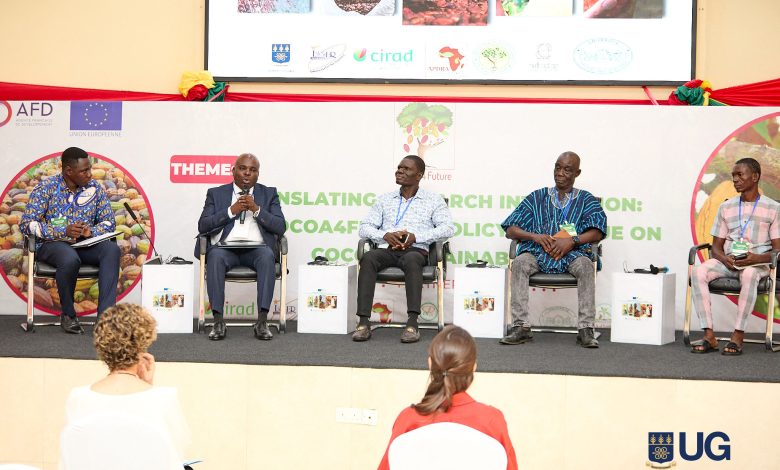
Researchers from the University of Ghana, CIRAD (Centre de coopération internationale en recherche agronomique pour le développement), the Cocoa Research Institute of Ghana (CRIG), and collaborating institutions in Côte d’Ivoire have unveiled fresh findings on cocoa production and sustainability. These insights formed the foundation of a policy dialogue aimed at converting outcomes from the EU and AFD-funded Cocoa4Future project into practical strategies for the cocoa industry.
The two-day forum, hosted at the Institute of Statistical, Social and Economic Research (ISSER), brought together stakeholders from government bodies, farmer associations, international research organisations, private sector players and development partners. Participants examined research results and jointly formulated recommendations to strengthen Ghana’s cocoa sector.
In his opening address, the Pro Vice-Chancellor for Research, Innovation and Development at the University of Ghana, Prof. Felix Ankomah Asante, stressed the critical role of evidence-based approaches in sustaining Ghana’s cocoa economy. He noted that the nation’s dependence on cocoa makes it imperative to scale up research and investment, particularly in light of recent data showing a decline in yields and overall output. He further explained that findings from the Cocoa4Future project offer vital guidance for building more resilient production systems.
Prof. Asante also highlighted the project’s contribution to developing academic and professional capacity. He pointed out that the training of PhD, Master’s and MPhil students under the initiative supports national efforts to grow expertise in agricultural research and development. He commended partners in Ghana and Côte d’Ivoire for their collaboration and noted that the workshop provided an opportunity to assess progress across the project cycle and convert results into concrete policy actions.
Ms. Paulina Rozycka, Head of the Infrastructure and Sustainable Development Section of the European Union Delegation to Ghana, reaffirmed the EU’s dedication to promoting sustainable cocoa production. She indicated that knowledge generated through the Cocoa4Future project presents a solid foundation for tackling challenges linked to agroforestry, cocoa swollen shoot virus disease, certification processes and farmers’ livelihoods. According to her, the findings introduce critical data that will shape ongoing discussions on sustainability within the sector.
She further emphasised the importance of sustained collaboration among researchers, policymakers, private sector stakeholders and local communities. She observed that sustainability relies on continuous consultation and praised the University of Ghana, CIRAD and CRIG for their leadership in bringing stakeholders together to develop practical solutions. She also recognised the participation of farmer groups and development partners, highlighting that their input is vital for transforming research into effective interventions.
Remarks were also delivered by the Country Director of the French Development Agency (AFD), Ms. Clémentine Dardy, and the Regional Director of CIRAD for West Africa, Dr. Serge Marlet. They underscored the need for coordinated action in implementing research-based initiatives and noted that the project’s findings reinforce the value of cross-border learning between Ghana and Côte d’Ivoire. They pointed out that shared evidence is essential in designing programmes that address persistent production challenges.
Research presented at the workshop identified several factors influencing cocoa production and sustainability. Field data revealed that agroforestry systems enhance soil quality, boost resilience to climate pressures and provide long-term advantages for farmers. Updated information on cocoa swollen shoot virus disease confirmed it remains a major threat to productivity in Ghana, with recommendations calling for more focused monitoring and control measures.
Findings related to certification and livelihoods showed that although certification schemes offer certain benefits, farmers need wider support, including fair pricing, improved access to credit and opportunities for diversification. Socio-economic analyses also demonstrated that land tenure systems, labour availability and household structures play a significant role in determining farmers’ capacity to adopt improved practices.
The dialogue forms part of the Cocoa4Future project, a research and innovation programme running from 2020 to 2026 and financed by the European Union and the Agence Française de Développement (AFD). The initiative, implemented by the University of Ghana, CIRAD and CRIG alongside partners in Côte d’Ivoire, seeks to promote sustainable agroforestry cocoa systems and improve socio-economic practices across the cocoa value chain. Over the past five years, the project has produced extensive research outputs, which are now being shared to guide policy formulation.
The Cocoa4Future project operates through a broad consortium of partners from Ghana and Côte d’Ivoire, including CIRAD and eight EU-recognised co-participant institutions representing 14 entities such as Université Félix Houphouët-Boigny, INP-Houphouët-Boigny, Université Jean Lorougnon Guédé, Université Nangui Abrogoua, Nitidæ and APDRA. The University of Ghana’s School of Agriculture and ISSER also play major roles. CRIG later joined the consortium as an additional co-participant, collaborating with CIRAD’s specialised research units including ABSys, Forests and Societies, PHIM, ArtDev, Innovation, QualiSud and ISEM, with further scientific backing from AMAP and CBGP.
The meeting featured presentations, breakout sessions and roundtable discussions, with participants expected to develop a policy brief on cocoa sustainability in Ghana. The workshop stands as a key platform for aligning scientific evidence with national priorities and strengthening efforts to secure the future of cocoa production in the country.
Source: UG